In the context of a Design Sprint, which Google Ventures made famous, the user testing portion of the Sprint process is a crucial step that takes place on the final day (Day 5) of the Sprint. The purpose of this phase is to confirm (or disprove) the remedies sought in the Sprint. In the Sprint, this is where crucial data (qualitative and quantitative) is gathered from the individuals who would be using the product or service that is being created. It also allows the Sprint team to minimize risk before investing in development, address usability challenges early, and obtain immediate feedback on hypotheses made throughout the sprint. For my team specifically, our finance app, PennyPal, was ready to be put to the test by real people, where they’d be able to tell us the advantages and disadvantages of our prototype. This is how we went through the operation and what we found!
User Testing
First, we followed the guidelines for Sprint Phase 4 to recruit 5 candidates for our user interviews. Secondly, we had to plan and carry out our user studies in accordance with the guidelines for facilitating and recording the process. And third, we had to examine the data gathered throughout the research, then, compile and arrange the discoveries and findings into practical actions for the products development. But I’m getting ahead of myself here! What exactly is user testing? The goal of user testing is to determine how simple and efficient a product is by watching actual users utilize it. It’s extremely important for the last phase of the Sprint process because the test shows what issues cannot be overlooked in the product’s overall success, and users will use it in unanticipated ways. Also, by making the program more intuitive, efficient, and enjoyable, testing can help retain users.

We had to recruit 3-5 people to interview for user studies, schedule and conduct said user studies, and collect and organize the data to see the best way to develop the product. These user tests are interviews that ranged from 5-10 minutes per participant, in which they were all asked the same set of questions. We could not interview someone that we knew, it had to be fresh faces with whom we have never seen before. For example, If Kyle is a friend of mine, I cannot facilitate him for this exercise. Our user tests revealed that PennyPal’s growth rate will be exponential if it concentrates on the Daily Trivia and Goal Tracker features. In addition, we discovered that its chat rooms need more of an entertainment sheen, improvements to the color scheme, and greater inclusion of the PennyPal mascot.
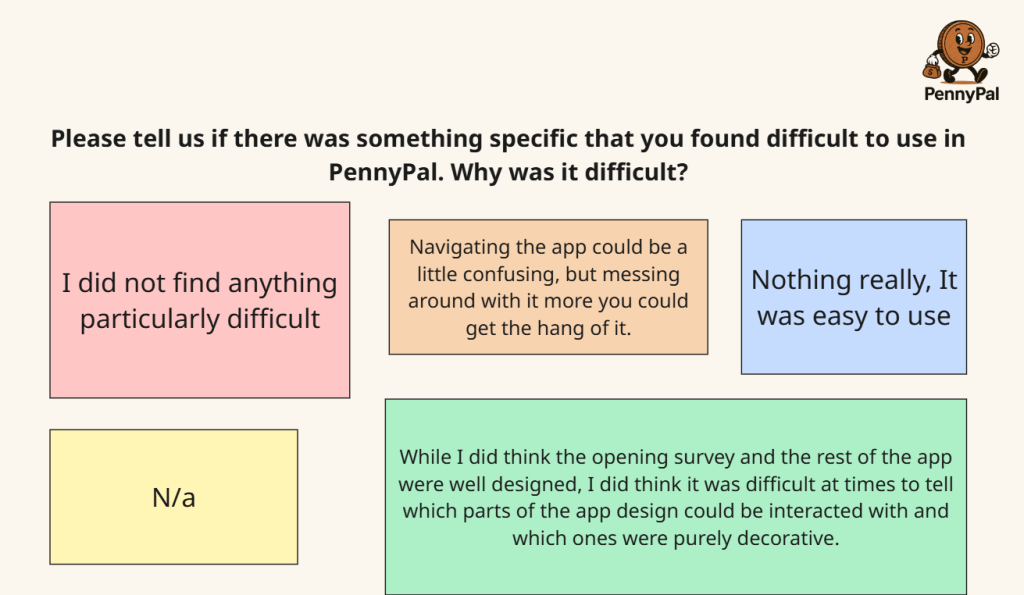
As you can see, user testing and feedback is critical to the success of a design sprint teams prototype. Having a few outsider pairs of eyes can help you spot issues and dilemmas that you didn’t think were there or could be there. I think the idea to use the PennyPal mascot more in particular would be a genius idea! It’s a kid-friendly marketers dream, with the penny’s big smile, cartoon hands and feet, along with its signature money bag that will be easily recognizable to Gen Z. But that’s not to say the other points the user testers made weren’t equally valid, because they were! Incorporating a slice or two of entertainment into the chat rooms will make it so that the tech-obsessed Gen Z doesn’t get bored and/or too overwhelmed with all the tutorial videos and stale 1-on-1 bot conversations. Leaning into the Goal Tracker and Daily Trivia features more with serve to keep Gen Z motivated to keep using the app, with the thrill of reaching a new milestone and turning the trivia questions into redeemable points can prove to be very lucrative.
 UX Journey
Leave a comment