Written, created, and designed by Nicholas Pagonis, without the use of AI
Here’s a breakdown of the meaning and significance of the article Gary Vaynerchuk published titled “Content is King, But Context is God.”
The article starts by acknowledging that in today’s digital world, brands and individuals are essentially media companies: producing and distributing content to build relationships, provide value and ultimately drive sales. But context matters more — The big point: content alone is not enough. You must deliver it in the right context for it to be effective. He uses the phrase: “Content is king, but context is god.”
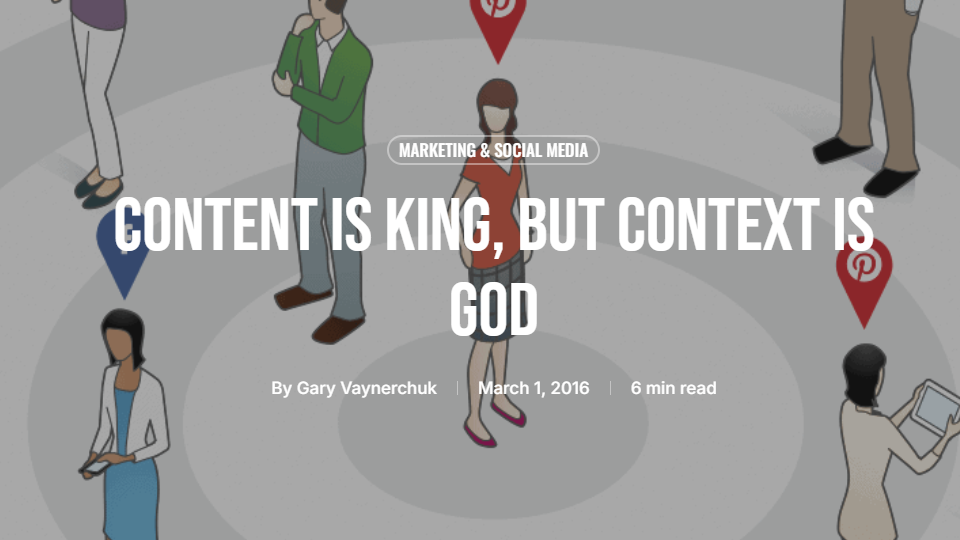
He gives three practical guidelines: First, respect the platform & audience. For example, understand what the audience is doing on a given platform and tailor your content accordingly (he talks about how a 40-year-old woman might behave differently on Facebook vs Pinterest). Second, don’t interrupt the experience. Meaning, if you deliver content that doesn’t fit the flow of the platform or annoys the user, you lose the chance to build a relationship (he gives the example of an intrusive mobile ad by Acura). Third, be consistent and self‐aware. Every piece of content builds your brand story. Your brand’s “north star” or purpose should guide content creation so that context aligns over time.
Without proper context (platform, audience mindset, brand narrative), even great content can fail to connect. Context enhances content’s reach, impact and authenticity. With the explosion of platforms (social media, mobile apps, streaming, etc.), the environment in which content is consumed is more fragmented than ever. This means simply “making a good piece of content” isn’t enough — you must consider where, how, and when it’s consumed. The article highlights that shift. It reframes content strategy from just “produce more content” to “produce content that fits the environment and purpose”. This is critical for brands trying to stand out and not just add to the noise.
Since users’ attention is scarce, delivering content without regard to context risks being ignored, or worse, being an annoyance. The article’s example (interruptive ad) shows that mishandling context can harm both perception and engagement. Vaynerchuk’s point speaks to the idea that anyone can be a “media company” now (brands, individuals). But success depends on mastering not just content creation but also distribution/contextualization. The three tips provide a practical framework. It’s not just a theoretical claim; the article gives actionable practices, which makes it useful beyond just inspiration.
At a deeper level, I believe Vaynerchuk is telling us that content without intention or fit is wasted. In a world saturated with messages, the ones that succeed are those that feel right in the moment and place of consumption.
“Respect the platform & audience” means: don’t treat all platforms the same; adapt.
“Don’t interrupt the experience” means: users are on a journey; if you force a message in the wrong moment you lose trust.
“Be consistent and self-aware” means: all content should point back to a larger purpose or identity; otherwise you’ll confuse your audience or dilute your brand.
So the article is really about alignment — aligning content with context (platform, audience, moment), aligning content with brand, and aligning content with the user’s mindset.
 UX Journey
Leave a comment