By Nicholas Pagonis

Intro
The collaborative workshop approach used by the hot air balloon UX design approach is used to determine the factors that support or obstruct a product, service, or experience. By picturing progress as a hot air balloon ascending into the sky, teams can identify both positive factors (wind and lift) and negative limitations (weights and anchors). Particularly during the early stages of design, retrospective evaluations, and strategic planning meetings, the approach works well.
Teams may better concentrate on priorities and identify hidden usability difficulties thanks to this method, which turns abstract feedback into a tangible visual representation.
What Is the Hot Air Balloon Method?
The hot air balloon approach is a visual brainstorming technique in which participants picture a product or project as a balloon trying to ascend. Enablers are the factors that cause the balloon to rise, while barriers are the factors that keep it from rising.
The approach promotes organized thinking about:
- Things that help you achieve success faster
- Flaws that impede advancement
- Outside prospects
- Internal restrictions
It encourages creative thought and less defensiveness during criticism sessions since it is metaphor-based.

How to Execute the Method: Step-by-Step Instructions
Step 1: Prepare the Visual Framework
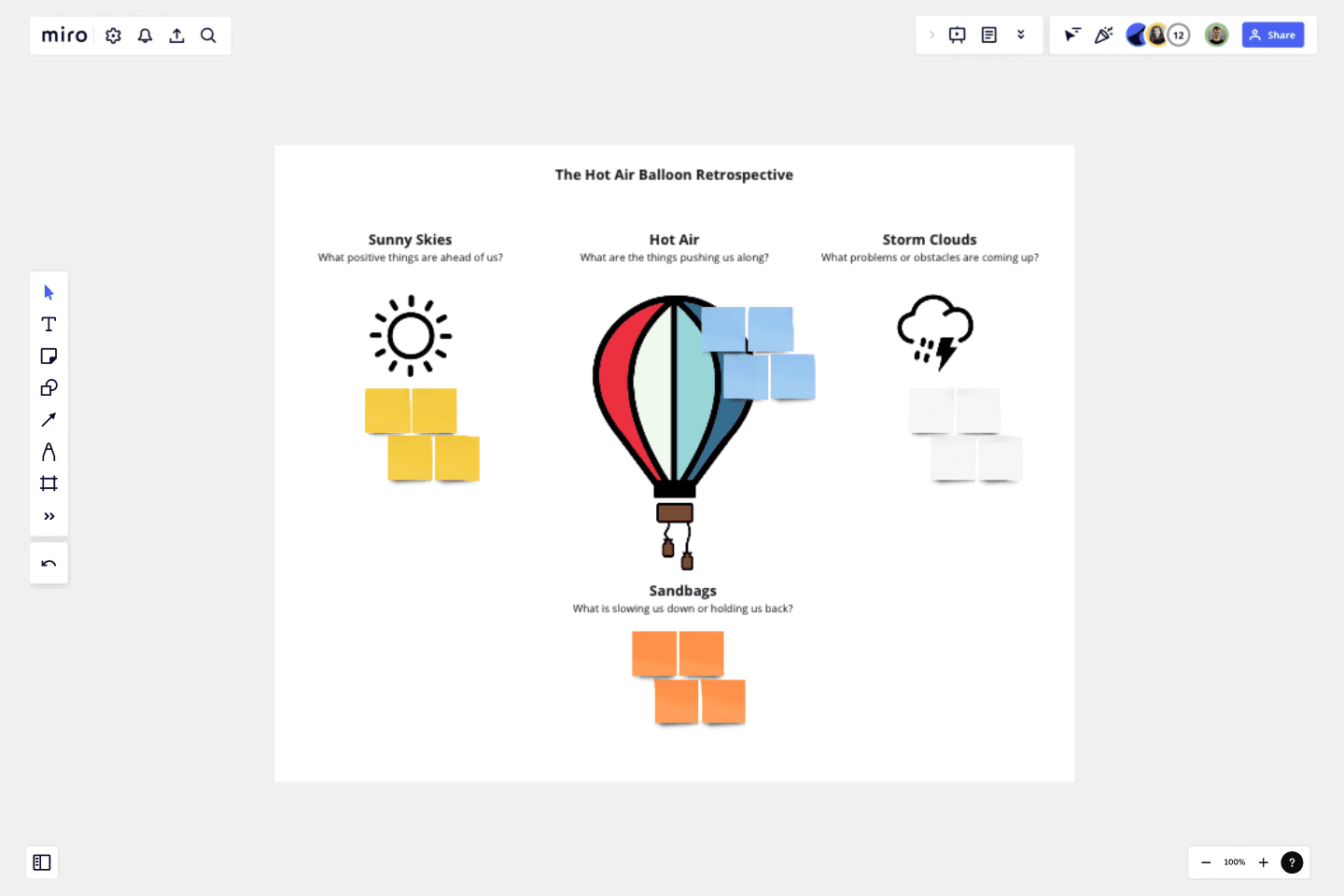
Draw or show a big diagram of a hot air balloon that is divided into sections:
- Balloon (goals and wishes)
- Wind or flames (driving forces)
- Sandbags or anchors (barriers)
- Destination or the sky (desired results)
This shared visual anchor helps to establish a common language and promotes group alignment.
Step 2: Define the Focus Question
Create a straightforward research question, such as:
- With the product, what helps users accomplish their objectives?
- What gets in the way of easy communication?
Brainstorming stays relevant and practical when it’s centered on a specific question.
Step 3: Individual Idea Generation
Ideas are written on sticky notes or digital cards by the participants:
- The balloon or wind is surrounded by positive forces
- The weights or anchors are surrounded by negative forces
Groupthink is lessened, and a range of opinions are solicited, by silent ideation.
Step 4: Group Discussion and Clustering
The group organizes related topics and analyzes its notes. Participants expand on important ideas and explain their reasoning.
The debate brings out common trends and clears up unclear feedback.
Step 5: Prioritization
The most important drivers and impediments are chosen by team voting. High-priority things are now targets for action.
Brainstorming becomes a roadmap for improvement via prioritization.
Step 6: Action Planning
Convert top insights into design suggestions or experiments.
This action guarantees that workshop results will result in real change.
Tools That Support the Method
The hot air balloon workshop may be facilitated by a variety of physical and digital resources.
Physical Tools
- Markers and whiteboards
- Sticky notes
- Big printed balloon templates
These tools are effective for collaborative in-person meetings.
Digital Tools
- For interactive whiteboarding, use Miro
- Figma for templates for structured diagrams
- A mural for online courses
Digital platforms allow dispersed teams to collaborate synchronously and retain artifacts for future study.
Research Applications and Case Studies
The hot air balloon approach has been employed in research and design practice as well, even if it is frequently used in industry workshops.
Study 1: Collaborative Ideation in UX Workshops
The efficacy of metaphor-based ideation tools in UX workshops was documented by researchers affiliated with the Nielsen Norman Group. Their results showed that visual metaphors, such the hot air balloon, enhanced participant involvement and produced a wider range of design ideas than conventional discussion formats. Visual frameworks led to more defined action items and greater agreement amongst teams.
Study 2: Participatory Design in Educational Technology
The hot air balloon technique was utilized in a participatory design project headed by a university to test an educational platform. Participants, including students and teachers, identified learning enablers and obstacles. The technique revealed discrepancies between user expectations and system capabilities. Later revisions raised user happiness and task completion rates.
Study 3: Innovation Workshops in Product Design
The hot air balloon approach was integrated into innovation workshops by design teams who drew inspiration from IDEO’s popular methods. According to internal reviews, teams employing the framework were able to recognize systemic impediments earlier in the design cycle, which resulted in less rework and a faster iteration rate.
Advantages of the Hot Air Balloon Method
- Promotes a fair discussion of both the advantages and disadvantages
- Gives abstract concepts a tangible form
- Promotes inclusive participation
- Generates actionable insights based on priority
Limitations to Consider
- Possible to oversimplify complicated systems
- Depends on well facilitated interaction
- May give more weight to perception than measurable facts
When to Use This Method
The hot air balloon UX design method is particularly useful when:
- Early prototype evaluation
- Carrying out a retrospective reviews of products
- Bringing stakeholders together around a plan
- Organizing workshops that cross disciplines
Its power comes from turning disparate input into a cohesive visual narrative that informs decision-making.
Conclusion
The hot air balloon approach is a potent and approachable UX design strategy that combines imagination and organization. Teams develop a common understanding of priorities and opportunities by visualizing the forces that either lift or weigh down a product experience. The approach turns into a useful engine for ongoing improvement when combined with smart facilitation and the right digital technologies.
 UX Journey
Leave a comment