By Nicholas Pagonis

Take a moment to scroll. With purpose, not aimlessly. Consider the last time you paused in the middle of scrolling—perhaps a video, a hashtag, or an image that caused you to pause and experience something. Nevertheless, social media activism starts with that little bit.
The act of speaking up for a cause on social media is frequently misconstrued as merely publishing, liking, or sharing content. However, it goes much deeper than that at its foundation. It involves using digital platforms to increase public awareness, establish communities, plan group activity, and ultimately advocate for social reform. The technology’s potency stems from the way people are able to utilize it to communicate, connect, and mobilize over boundaries that were previously thought to be insurmountable.
Social media sites now operate as a sort of worldwide meeting place, a “digital village” where individuals may see events, exchange experiences, and engage in live discussions. Social media empowers everyday people to become storytellers, organizers, and activists, unlike traditional media where information flows from a small number of central sources. Social movements now operate in a very different manner because of this transformation. Nowadays, activists may generate momentum from the bottom up, frequently beginning with a single piece, rather than depending just on institutions or formal groups.
Think about how movements are created now. The hashtag is displayed. A story spreads. A video becomes popular online. A moment of consciousness may quickly grow into something greater—a community of individuals united by a shared sense of worry and aim. Scholars refer to social media as dense networks of communication, where people create connections, share data, and develop shared identities. Together, these relationships form the basis for group action, whether they are transient or enduring, powerful or weak.
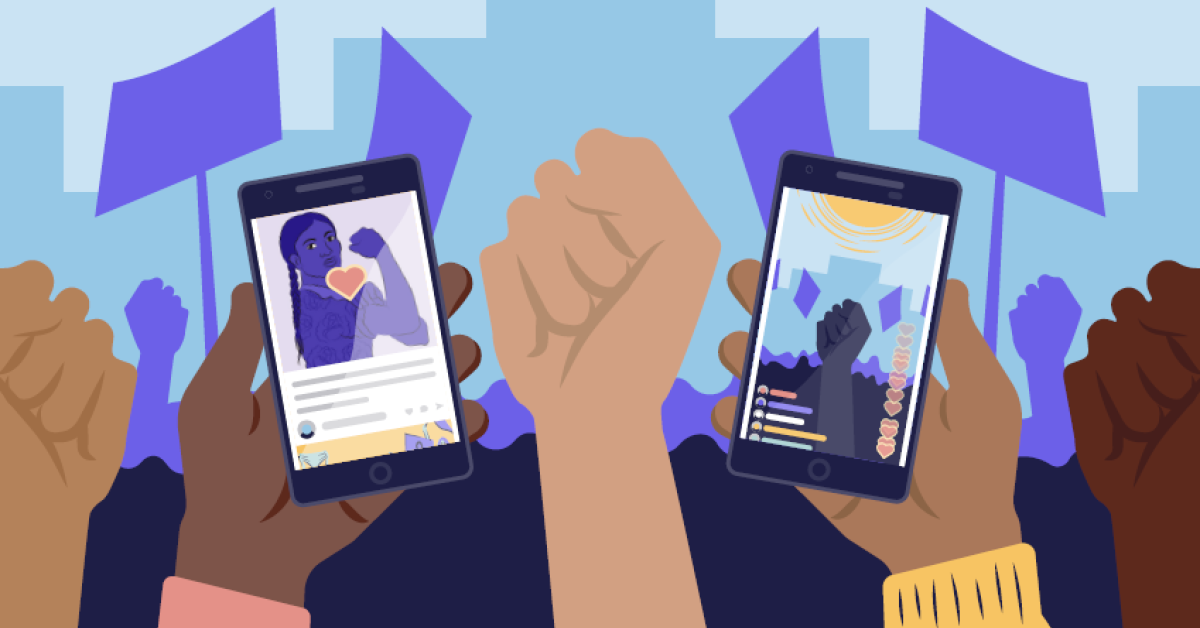
The capacity of social media activism to blur the boundary between the online and offline worlds is one of its most enticing features. Writing about an issue isn’t always the conclusion; it’s frequently the start. Compared to the past, digital platforms enable quicker and more effective coordination of protests, organization of campaigns, and mobilization of resources. In many cases, what begins online shifts into the real world, affecting public opinion and sometimes even legislation. In this way, social media serves as both an instrument and a catalyst for societal change.
Social media activism, meanwhile, has its drawbacks. The term “slacktivism”—the notion that online interaction is superficial or unproductive—may have come to your attention. This critique has a degree of validity. Sharing a message or clicking “like” might give the impression of participation without necessitating a greater level of engagement. However, completely ignoring the effects of social media activism ignores its wider impact. Visibility is frequently the first step towards change, and even minor acts help raise awareness. As research has shown, online interaction may aid in raising awareness, fostering community, and laying the groundwork for more long-lasting kinds of activism.
In addition, there are structural restrictions to take into account. The internet is not a fair environment. The content that is seen and shared is influenced by the businesses that own and run them. Prioritizing engagement, algorithms can amplify some voices while silencing others. Furthermore, there is an uneven distribution of access to technology and digital literacy, which means that not everyone has equal opportunity to participate. These restrictions serve as a reminder that social media, despite its innovative potential, still mirrors the inequalities that already exist in society.
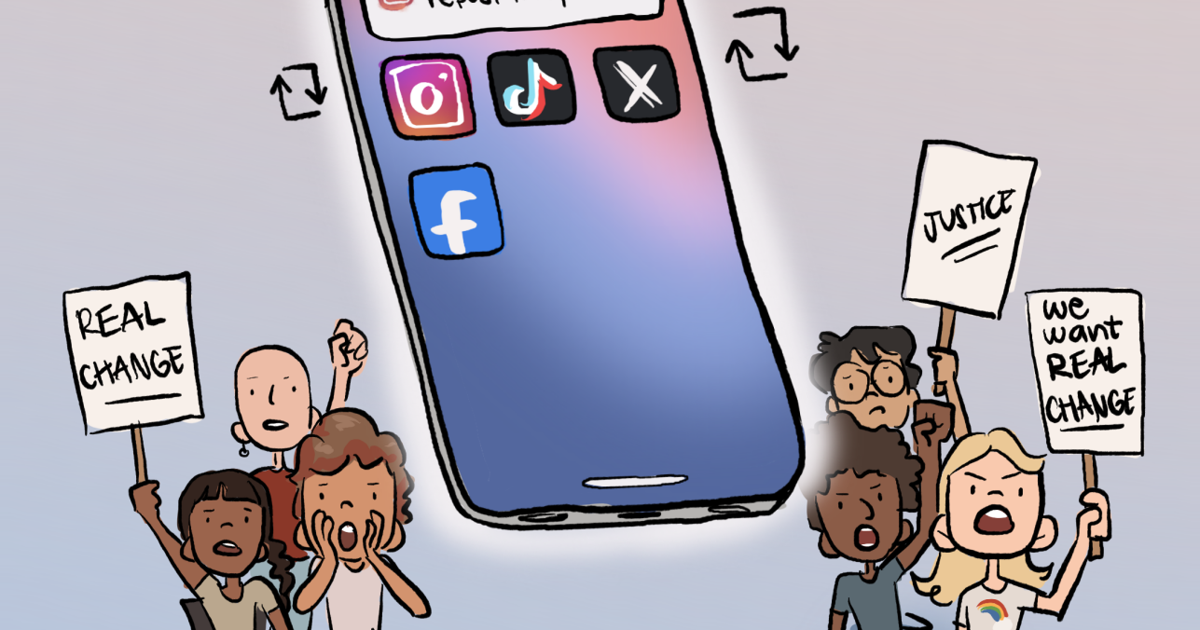
Nonetheless, social media’s capacity to benefit the public is undeniable. It enables marginalized voices to be heard, stories to be shared, and injustices to be brought to light in ways that were formerly challenging or unachievable. It provides room for discussion, debate, and shared contemplation. It allows individuals to interact with the world rather than just observe it.
Therefore, as regular users browsing our feeds, where does that leave us? Instead of asking if social media activism “works,” maybe the more pertinent issue is how we choose to interact with it. Do we just scroll on, or do we pause and reflect? Do we share without considering, or do we try to comprehend? Do we see social media as a distraction or as a means of raising awareness and promoting change?
Social media activism urges us to reevaluate our place in society. It opposes the notion that change is “out there,” guided by others. Rather, it implies that change can start with us—with our attentiveness, our words, and our willingness to participate.
Think about the cause of your mid-scroll pause the next time it happens. That instant of concentration is not little. It serves as the beginning of knowledge, which in turn serves as the basis for behavior. Even the tiniest exchanges can have far-reaching effects in a world that is becoming more and more dominated by digital relationships, perhaps even leading to events far beyond our imagination.
For all of its drawbacks, social media has a special potential: It empowers ordinary citizens to contribute to the world’s future. The issue is not whether that power exists, but rather how we decide to employ it.
 UX Journey
Leave a comment