UX Journey

Nicholas Pagonis

  • Written, created, and designed by Nicholas Pagonis, without the use of AI

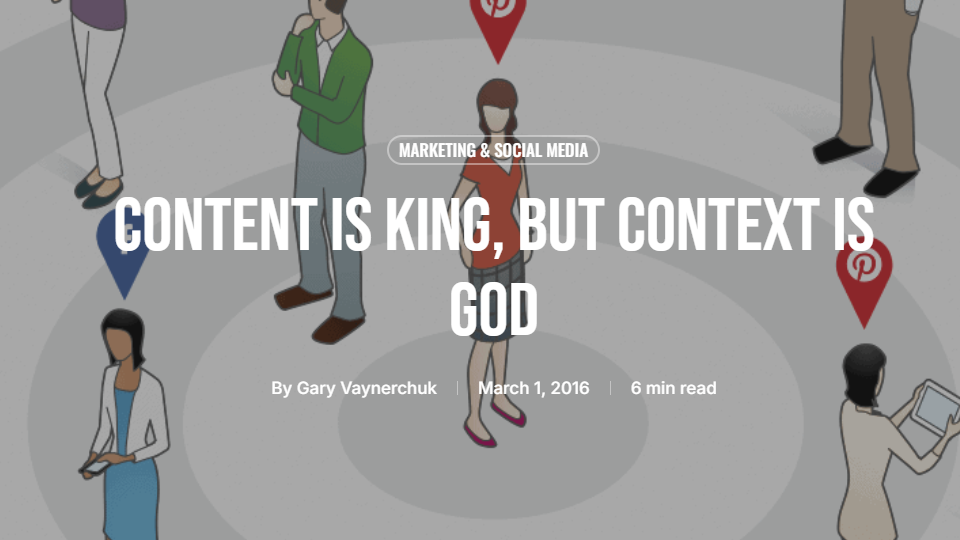
    Here’s a breakdown of the meaning and significance of the article Gary Vaynerchuk published titled “Content is King, But Context is God.”

    The article starts by acknowledging that in today’s digital world, brands and individuals are essentially media companies: producing and distributing content to build relationships, provide value and ultimately drive sales. But context matters more — The big point: content alone is not enough. You must deliver it in the right context for it to be effective. He uses the phrase: “Content is king, but context is god.”

    He gives three practical guidelines: First, respect the platform & audience. For example, understand what the audience is doing on a given platform and tailor your content accordingly (he talks about how a 40-year­-old woman might behave differently on Facebook vs Pinterest). Second, don’t interrupt the experience. Meaning, if you deliver content that doesn’t fit the flow of the platform or annoys the user, you lose the chance to build a relationship (he gives the example of an intrusive mobile ad by Acura). Third, be consistent and self‐aware. Every piece of content builds your brand story. Your brand’s “north star” or purpose should guide content creation so that context aligns over time.

    Without proper context (platform, audience mindset, brand narrative), even great content can fail to connect. Context enhances content’s reach, impact and authenticity. With the explosion of platforms (social media, mobile apps, streaming, etc.), the environment in which content is consumed is more fragmented than ever. This means simply “making a good piece of content” isn’t enough — you must consider where, how, and when it’s consumed. The article highlights that shift. It reframes content strategy from just “produce more content” to “produce content that fits the environment and purpose”. This is critical for brands trying to stand out and not just add to the noise.

    Since users’ attention is scarce, delivering content without regard to context risks being ignored, or worse, being an annoyance. The article’s example (interruptive ad) shows that mishandling context can harm both perception and engagement. Vaynerchuk’s point speaks to the idea that anyone can be a “media company” now (brands, individuals). But success depends on mastering not just content creation but also distribution/contextualization. The three tips provide a practical framework. It’s not just a theoretical claim; the article gives actionable practices, which makes it useful beyond just inspiration.

    At a deeper level, I believe Vaynerchuk is telling us that content without intention or fit is wasted. In a world saturated with messages, the ones that succeed are those that feel right in the moment and place of consumption.

    “Respect the platform & audience” means: don’t treat all platforms the same; adapt.

    “Don’t interrupt the experience” means: users are on a journey; if you force a message in the wrong moment you lose trust.

    “Be consistent and self-aware” means: all content should point back to a larger purpose or identity; otherwise you’ll confuse your audience or dilute your brand.

    So the article is really about alignment — aligning content with context (platform, audience, moment), aligning content with brand, and aligning content with the user’s mindset.
  • AI GENERATED

    The essay in a nutshell

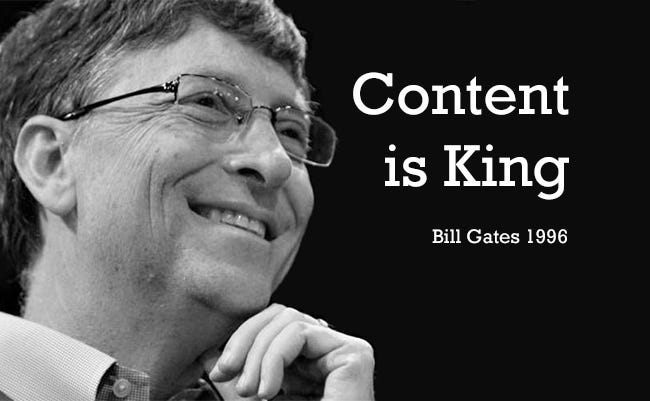
    In January 1996, Bill Gates wrote an essay titled “Content Is King”, in which he argued that on the Internet, content—not the infrastructure itself—would become the primary business driver.

    He highlighted a few key ideas:

    The Internet allows anyone with a PC and modem to publish content globally at very low marginal

    The definition of “content” is broad: software, entertainment, information, communities.

    Traditional print, magazine, and broadcast media would need to rethink how they adapt online—they can’t simply move print-editions to the web without adding interactivity and depth.

    Though the revenue models were shaky then (subscriptions, advertising), the long-term opportunity for monetizing content in new ways was real.

    Why this essay still matters

    1. Visionary in hindsight

    At the time—mid-1990s—the Internet was early stage. Gates’s point that “content is where I expect much of the real money will be made” is striking given how dominant content (streaming services, social media, user-generated platforms) has become.

    In retrospect, his insight foreshadowed the shift from infrastructure (dial-up, ISPs) to experiences (apps, communities, media).

    1. Broadening “content”

    Gates didn’t restrict content to articles or entertainment. He included software, games, online communities. That helps explain how many business models we now see—platforms built on software, services, interactive participation—not just passive media.

    1. Democratization of publishing

    One of the powerful lines: “Anyone with a PC and a modem can publish whatever content they can create.”

    This presaged the creator economy, user-generated content, blogs, YouTube, podcasts. The barrier to entry fell, shifting power from few large media houses to many individual creators.

    1. Monetisation remains a challenge

    Even back in 1996 Gates was cautious: subscriptions barely worked, advertising on the web was nascent.

    This reminds us: even when the opportunity is clear, execution (monetisation, scale, engagement) is non-trivial. Many content ventures still struggle.

    1. Interactivity matters

    Gates pointed out that print content just transplanted online wouldn’t cut it: users expect depth, interactivity, multi-media.

    That’s why successful content now engages users with comments, sharing, video/audio, live interaction—not just static pages.

    Implications for today

    For businesses: If you run a company with an online presence, you should think of your website not just as a brochure, but as a content ecosystem. Quality content drives trust, retention, discoverability.

    For creators: The idea that “content is king” offers encouragement: focus on value, authenticity, engagement. The platform infrastructure will continue to evolve, but the core remains the content you deliver.

    For marketers: Content marketing isn’t new—it’s rooted in this early vision. The key remains: deliver something of value, make it interactive, build community, and monetise thoughtfully (ads, subscriptions, sponsorships, services).

    For technologists/platforms: The infrastructure is necessary but not sufficient. The winners often build around content ecosystems: think streaming platforms, social networks, gaming hubs. Infrastructure enables, but content keeps people engaged and coming back.

    A few questions to ponder

    In a world saturated with content, what makes your content stand out? How are you adding interactivity, value, uniqueness?

    How are you structuring monetisation? Is it purely ad-based? Is there a subscription or membership element?

    How are you building community around your content, rather than just publishing alone?

    Is your content aligned with your broader purpose/brand? Gates pointed out that content is important—but it must serve an audience with intent and value.

    Final thoughts

    Bill Gates’s “Content Is King” essay may have been written in an early era of the Internet, but its core message remains relevant: in the digital age, what you deliver—information, entertainment, software, experiences—carries the long-term value.
    As infrastructure and platforms become ever more powerful and accessible, the differentiator remains: great content, well-delivered, that engages and provides value to people.
    In short: content isn’t just king—it’s the kingdom.

  • How To Define and Target a Webinar Audience | Hubilo

    The apparent contradiction between “don’t lose the reader to distraction” and “write for yourself, not for the reader” is more of a tension that you are being asked to maintain than a rational inconsistency. I break down the two impulses here, explain how they function at various levels and phases, and offer useful advice for managing them so that your work remains honest and successful.

    The reader must not be diverted. This is a tactical, craft-level guideline. It concerns the economics of attention, which includes a clear structure, pacing, hooks, signals, and the elimination of friction (such as awkward language, irrelevant digressions, and perplexing organization). Its goal is to communicate: to make sure the concepts get across, the reader is kept interested, and there are no barriers to understanding. When you look at it this way, one cares about the reader’s experience of the text, and the other cares about the author’s motivation for writing it.

    What is a Target Audience? | Directive

    When writing, you frequently write for yourself: follow your curiosity, note your findings, and allow strange connections to occur. During revision, you write for the reader by pruning, reordering, clarifying, and adding signposts. The first one makes stuff, while the second one shapes it into something that speaks. “Write for yourself” maintains your unique perspective, preventing readers from becoming bored by generic writing. “Don’t lose the reader” guarantees that uniqueness is packaged in a way that others can receive it. Craft without authenticity may be forgotten; authenticity without craft may be unintelligible. Writing for oneself can include writing for one’s inner reader, which is the part of oneself that recognizes nuances and omissions. The internal reader’s shorthand is converted by revision into the language of the external reader, who does not have that intimate understanding.

    Avoid “write for yourself” when it turns into an excuse by doing the following. Force yourself to express the notion in a single statement after writing a creative draft. You should likely provide readers with additional clarification if you are unable to. Reading aloud is another option, where you can hear the reader’s potential stumbling blocks. Also helpful is using a new reader as a gauge. Make sure to pose a specific question, such as “Where were you lost?”

    However, if “don’t lose the reader” becomes pandering, here is how to remedy it. Ensure that there is at least one obstinate, unique feature that you won’t get rid of. It maintains a unique viewpoint. In addition, make reader-focused changes that improve your voice (clarify imagery, tighten structure) rather than change it. The two pieces of advice are complementary: use “write for yourself” to produce honest, interesting material; use “don’t lose the reader” as the revision discipline that shapes that material into writing others can and will read. Hold both at once — protect your voice, then refine how it reaches people.

    8 Dos & Don'ts of Search Audiences
  • A leap into the unknown: how 'design fiction' is shaping our future | Neste

    The innovative and speculative design methodology known as Design Fiction (sometimes called Design for the Future) employs narrative, prototyping, and visual artefacts to investigate potential, realistic, or thought-provoking futures. Futurist Bruce Sterling invented and popularized it, and designers like Julian Bleecker have since refined it. Its focus is on utilizing design to think, rather than foreseeing the future. to question assumptions, consider alternatives, and initiate conversation regarding it.

    Design Fiction, Design spéculatif : Comment transformer la créativité en un  avantage concurrentiel

    The fundamental tenet of Design Fiction is hypothesis above solution. Instead of addressing current issues, design fiction envisions “what if…” situations, looking at technologies, systems, and cultures that may exist. The second fundamental idea is that narrative may be used as a tool. Designers create fictitious worlds or stories, such as movies, posters, mockups, etc. prototypes, interfaces) to give those futures a sense of reality and tangibility. The third and last fundamental tenet is critical reflection. It fosters discussion rather than “is.” not “is this possible?” but rather “what would it mean if it did?” or “should this happen?”

    Design Fiction: A Method for Exploring Ways Forward and for Building the  Future? - Futuribles

    The believability, relatability, and emotional impact of speculative futures depend heavily on visual design. Visual communication, such as concept art, UI mockups, product renders, film props, and posters, is frequently used in design fiction to give ideas shape. As an illustration, a fictitious smartphone interface for an AI-run government helps viewers consider the moral and social ramifications of monitoring. Additionally, effective visual design contributes to the “diegetic believability” of the fiction, making it seem realistic enough to hold disbelief. How people interact with speculative artifacts depends on their appearance and sensation. In addition, designers employ visual storytelling to spark ideas rather than to promote. News pieces, product advertisements, museum displays, posters, zines, and interfaces may all replicate imagined futures.

  • By Nicholas Pagonis

    The following images are from the Call of Duty: Black Ops 3 Zombies map, Der Eisendrache. It tells the story of the Wolf King who once led a mighty army and spread prosperity throughout his land and to his people. There’s zero words contained in his paintings, yet they all speak volumes of what went down on these once royal grounds. From the vast color pallet to the cohesive narrative from one painting to the next, it’s a tale chock full of meaning and substance.

    Great King Prepares For Battle… Mans Best Friend At His Side. With the way the king and his wolves are posed, this painting appears to be a self portrait. It’s almost as if he knew they would be going down fighting, like he wanted his next of kin to remember him as a valiant, steadfast, and courageous leader. The light shining onto the king and his wolves gives the viewer a glimmer of hope as to the outcome of their upcoming war. The kings armor and sword are made of the finest steel ever forged, the hounds look healthy and unwaveringly loyal, and the insignia on the kings shield glows with an unmistakably majestic aura that will prove to be everlasting throughout the story.

    When Armies Clash… The king, his wolves, and his comrades claw and scratch their way through the battlefield to protect their kingdom. The arrow-ridden grounds are scattered with smoke and bodies of allies and enemies alike. The bright colors contained in the sky and the yellowish hue of the painting could imply that the tides have been turning in the kings favor. One of his wolf companions scours the terrain, for it is his duty to be a vicious bodyguard. His noble steed is alive and well, his white hair being the only pure, good thing in the painting. The king himself proudly waves his royal insignia up high, hopefully being able to secure the victory for himself and his people.

    A War With Hell. This is where our story takes a much darker turn. Fire and brimstone surround the kings castle, engulfing any and all land in the area. The sky is lit up furiously with vibrant red and orange strokes, and the kings sword and shield are stranded amidst the rubble and destruction. But the real attraction of this piece is the giant tentacle monster emerging from the darkness of the clouds. It sends irate lightning bolts crackling through the atmosphere and flashes it’s evil purple energy around it. It appears that whatever it was that the king was up against was far out of his depth. It clearly wiped the floor with him and his army, a stark contrast to the previous two paintings.

    Only One Outcome. After all the carnage and chaos, the war is over. And unfortunately for our Wolf King, he has succumbed to his injuries, dying beside his distraught wife and royal insignia. The painting is very dark and indicates that the king died in a forest. It’s devastating seeing the arrows in his shoulder, his body slumped over, his wife crying hysterically, and his wolves nowhere to be found. Then the thought creeps in suddenly, that perhaps the wolves didn’t make it either. As we’ll see in the rest of the pictures, that is most definitely the case…

    Reunited At Last. Many eons later, four travelers discover the Wolf Kings castle and put the pieces back together of these defiled grounds. It seems that one of the wolves’ remains are scattered throughout the Wolf Kings land, and it’s vital that the travelers reunite it’s skull with it’s body. Perhaps the wolf cannot be put to rest until it fulfills it’s mission and duty to it’s king, judging from the blue aura around the skull.

    A Haunting Mission. The travelers end up finding the skull of one of the kings wolves, and it’s spirit awakens. It travels all around the castle, sniffing the ground and digging up objects of some kind. The blue and black smoke radiating off the wolf along with the paw prints leave a ghastly trail behind. The wolf perfectly displays what real loyalty looks like: Looking out for your closest allies even from beyond the grave. We’ll finally get to see the ending of this tragic tale and the wolf’s plan revealed!

    Finally Laid To Rest. As it turns out, the wolf was gathering the bones of it’s master, it’s partner in crime, it’s best friend. Throughout the centuries of disrespect of the kings castle and land from one generation to the next, his bones were lodged all around the area in disarray. The wolf was trying to give it’s king a true, proper burial, and it succeeded. With the help of the four travelers, the king is able to bestow the power of his wolves’ spirits into a mighty bow and arrow. Fitting for a king and his hounds that charged straight into the heat of battle to protect their sacred kingdom!

  • Nick Pagonis is a motivated young mind who hails from Long Island, New York. He wishes to utilize his education and related work experience in a position which offers growth and personal enhancement. He graduated from Kings Park High School in 2018 and studied at Suffolk Community College for his first 2 years. He set his sights on a communications degree after much confusion and frustration as to what he wanted to do with his education. He finished his Professional Communications journey at Farmingdale State College for his last 3 years as an undergraduate. Now, having a much clearer picture as to his path and calling, he is currently pursuing a masters degree for Interactive Media and Communications at Quinnipiac University.

    Kings Park High School in Kings Park, NY - Homes.com
    Kings Park High School, where Nick graduated with a Regents diploma in 2018.
    Academic Learning Centers - Ammerman Campus
    Suffolk County Community College Ammerman campus, where Nick earned his Associates degree in 2021.

    At the moment, he is undecided as to what he wants to specifically pursue in the field, but he’s eager to make a name for himself no matter what and by any means necessary! He has taken a curious look at all things marketing however, as an intriguing internship opportunity has arisen that he recently applied for. Nick became interested in interactive media and communications within the past few months after a long journey of searching for a career that suits him best. He prides himself as an excellent writer and being passionate about technology, so it’s only natural that he would be attracted to Quinnipiac’s ICM program.

    Home | Quinnipiac University
    Nick’s current college campus, Quinnipiac University.

    Nick took the Design Sprints course to start off his masters degree trek, and he thoroughly enjoyed building a finance app from scratch with his team members. Learning the ins and outs of the Miro program, practicing techniques like Storyboarding, heat map voting, etc., and crafting a White Paper on the dangers of prevalent social media use in today’s society have been incredibly exciting and interesting for him. He’s already jumping right into his Writing Interactive Media and Visual Storytelling classes, having filled out a persona template for the latter!

  • Online MS in Interactive Media and Communications
    Quinnipiac University offers the most fun and inspirational classes!

    Having successfully completed not one, but TWO courses in Quinnipiac’s ICM program, I’ve been been quite eager to start the Fall 2 semester. Kicking things off with the Design Sprints class was challenging, but fun and interesting to learn about. Foundations Graduate Studies was up next, and while it wasn’t as nearly as group work focused, the White Paper assignment at the end of the course was a fascinating way to end things. Now, for my third scrumptious serving of Interactive Media and Communications, I have joined up with the Writing Interactive Media brigade led by Professor John Powers. And so far, it’s been a strong contender for the best class in the program!

    The textbook that I’ve began diving into is titled On Writing Well by William Zinsser. It’s incredibly informative judging from the first chapter alone, no doubt the rest of it is filled to the brim with countless amounts of sound advice. Having an Audible subscription for 15 dollars a month comes in handy, considering the rising cost of physical textbooks these days! I have a good feeling that I’ll be using the knowledge contained in this gem for many years to come, as I actually aspire to write some novels when I get my career going.

    The first class was pretty straightforward, as Professor Powers especially wen over the syllabus for the course and took any questions we had. All of my classmates seem like good people who are just as eager to finish their education here at Quinnipiac as I am! I had just finished my shift at work at 6PM, so I logged onto Zoom using my phone for the drive back. It felt great to be complimented for my dedication to the course by the professor himself! I wanted to make sure I started off on the right foot, but I didn’t think I’d be doing that literally! Don’t worry, I made sure to keep my eyes on the road!

    How to Handle Doctor's Note Requests: Can Your Employer Demand One?
    There’s never an excuse to miss your classes unless there’s a medical emergency!

    For our assignments this week, we first had to write a brief paragraph introducing ourselves to the class, discussing our educational and personal backgrounds. We could also talk about what brought us to the Interactive Media and Communications field as well. We then had to choose two pieces of online content (one well written and the other poorly written) and compare and contrast them. Then, we had to give feedback to our classmates on what they wrote, two people for each assignment. Everyone that I got assigned did great on their passages! Finally we have to make a blog post on WordPress sharing our first week experience in the class, which is what you’re reading right now!

    All in all, I enjoy Writing Interactive Media so far and look forward to meeting with my class every Wednesday! I think it’ll be a thrilling and challenging opportunity to not only advance my expertise in the ICM program here at Quinnipiac, but also to personally improve my own writing for my future endeavors! Cheers to whatever it is that lies ahead!

  • How Technology is "Downgrading Humans" (Tristan Harris X Capgemini)

    Human Downgrading, one of the Center for Humane Technology’s core ideas, links a wide range of societal ills to the extractive attention economy, which is the root cause of all of them. Modern digital platforms, rather than giving us power, undermine our human skills, such as our ability to focus, our mental health, our critical thinking, our relationships, our participation in society, our democracy, and so on.

    In public presentations and professional testimony before the US Congress, Tristan Harris and CHT stress that these damages are not isolated but rather systematic and reinforcing, creating a “dark cloud” that diminishes our overall human potential.

    Gilbert K. Chesterton quote: To downgrade the human mind is bad theology.

    Some of the “Human Downgrading” framework’s important aspects are interconnected harms, system-level clarity, a call to action across all sectors, and a common narrative to bring about change. Unlike treatments that address problems like addiction, polarization, or disinformation independently, CHT demonstrates how harms are related and originate from the same root: technology that prioritizes capturing attention above all else. By giving the interconnected problem a name, CHT facilitates coordinated solutions. The terminology promotes cooperation between community development, education, policy, and design initiatives.

    By incorporating human values into product design, designers are moving away from addictive mechanics and focusing on enhancing well-being. Tech employees use shared language to promote structural change inside the organization. Additionally, legislators want safeguards and inducements that would offset the extraction-driven current situation. Making a consistent story not only describes the issue, but it also fosters systemic change and collaboration.

    Former Google Ethicist Tristan Harris on Tech's 'Human Downgrading' : It's  Been a Minute : NPR

    By concentrating on Human Downgrading, we can move beyond individual symptoms, such as political fragmentation or social media addiction, and address the underlying economic models and designs that cause them. It facilitates collaboration across sectors in order to redesign technology in a way that improves rather than impairs human capabilities. The approach of CHT is not to give up on technology but to redesign it so that it supports human well-being rather than taking advantage of cognitive weaknesses. Their goal is to transform the ongoing “arms race for attention” into an “arms race for human benefit.”

  • Book Review: “Stolen Focus” (Johann Hari) | Garth Nichols

    In Stolen Focus Chapter 8, The Rise of Cruel Optimism, Johann Hari explores the concept of “cruel optimism” primarily in the context of how we approach attention loss and productivity in modern society. The term “cruel optimism,” originally coined by theorist Lauren Berlant, refers to situations where the things people hope for are actually obstacles to their flourishing — where the object of desire becomes part of the problem.

    According to Hari, many of today’s self-help recommendations on attention and productivity, such as time management tips, digital detox apps, and mindfulness training, provide a sort of cruel optimism. While these tools claim to help us regain our focus, they divert our attention from the underlying, structural reasons for our attention loss, such as surveillance capitalism, data-driven social media algorithms, excessively exciting digital environments, and work cultures that cause burnout.

    Battling Back our Stolen Focus

    People are led to believe that they may improve their focus by simply working harder, even if the underlying causes are beyond their own control. The optimism is “cruel” because it fosters false hope and prevents people from calling for more significant societal change. The fixation with self-discipline in culture is criticized by Hari. He argues that it is not only ineffective to instruct people to just use more willpower to concentrate in an environment that is intended to distract them, but also demoralizing. Again, this demonstrates cruel optimism: attempting to flourish in a system that almost prevents it.

    The book also promotes the naive notion that the same tech firms that gain from attention fragmentation will one day create solutions to enable users regain their concentration. According to Hari, this is foolish since it’s like asking arsonists to come up with fire prevention plans.

    Book Review: “Stolen Focus” (Johann Hari) | Garth Nichols

    Johann Hari uses the concept of cruel optimism in Stolen Focus to demonstrate how society pushes people to look for individual answers to what are actually systemic issues. When it prevents individuals from addressing the technological, economic, and cultural structures that are initially diverting their attention, optimism turns harsh by trapping people in cycles of self-blame and delusion.

  • Project Management : What Is Project Management ? - PM 360 Consulting

    The process and outcomes of how I would choose and establish a project management system are clearly explained here. This may be modified to fit a class project, a team, or a business. I would start by determining the needs of my team and the kind of work we handle. Some of my main factors are the number of users, the complexity of the task, the need for collaboration and communication, the budget, and the integration with applications such as email, calendars, and file storage. I may also think about the project’s nature (such as agile, waterfall, or hybrid) and if time tracking or Gantt charts were needed. I would compare numerous platforms, such as ClickUp for its adaptability and comprehensive features, or Trello for its straightforwardness and visual design. I would compare each platform based on things like cost, features and personalization, mobile access, and user-friendliness.

    I would then run 1-2 week trials with two platforms of my choice, such as ClickUp and Asana, once the basics were in place. Every day, my team members would assess how things were being used, such as assigning tasks, establishing deadlines, and making comments within projects. Feedback will then be gathered on how easy it is to use, how well the workflow is visible, how effective the alerts are, and how clear the dashboard is. Suppose that, in the end, I selected ClickUp because it strikes a balance between structure and flexibility and can accommodate a variety of team sizes and project types.

    The Complete Guide to the Project Management Office | Acuity PPM

    After a program was chosen, my team and I followed a series of steps. We would organize spaces by departments and major project types, create the main workspace, create project templates for common task structures, and add unique fields to monitor priority, status, deadlines, and ownership. Finally, we will provide cheat sheets and conduct a one-hour training session for team members. We would discover that the project management system has had a significant effect. The outcome would be something like greater clarity, with team members understanding their responsibilities and deadlines. Members would communicate more effectively, and centralized comments would lessen the amount of disorganized email conversations. With templates and automation reducing monotonous setup, there would also be time savings.

    The Difference Between Project Managers and Scrum Masters | Scrum Alliance

    By taking the time to define my needs and my team’s needs, compare tools, and roll out a system with collective input, We achieved a smoother workflow and more efficient project execution. Regular reviews ensure we continue to optimize the system as our needs evolve.